
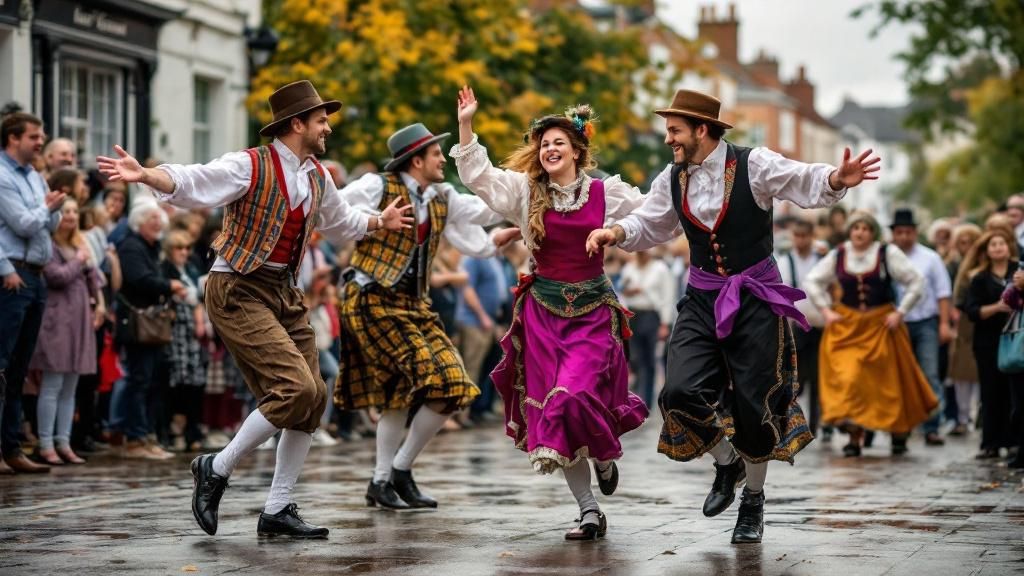
Once dismissed as a nostalgic echo of England’s pastoral past, Morris dancing is witnessing an unexpected revival amongst Britain’s younger people. From student groups to rural commons, enthusiasts aged under thirty are reviving interest in the rhythmic footwork, bell-adorned accessories, and bright garments that have characterised this ancient custom. This article investigates the factors driving this cultural resurgence, examines how modern dancers are reworking the style, and explores what this revived engagement reveals about current British views towards heritage and community.
The Cultural Resurgence of Morris Dance
The revival of Morris dancing amongst young people across Britain demonstrates a striking departure from decades of declining participation. What was once perceived as an purely rural or older pursuit has become a lively cultural phenomenon, with university societies, urban dance groups, and community organisations enthusiastically adopting the tradition. This comeback challenges traditional perceptions and shows that young people today genuinely appreciate maintaining and honouring Britain’s folkloric heritage, revitalising practices that seemed destined for obscurity.
This revived interest extends beyond mere nostalgic curiosity; young performers are deliberately transforming Morris dancing for contemporary times. They incorporate contemporary music, explore innovative choreography, and create welcoming groups that embrace dancers regardless of heritage or previous training. The movement demonstrates a wider cultural change wherein British youth deliberately look for real ties to their ancestral traditions whilst simultaneously redefining tradition’s significance, fostering a dynamic dialogue between cultural accuracy and contemporary expression that resonates with what matters to their age group.
Why Young People Are Adopting This Time-Honoured Craft
Morris dancing’s attraction for younger generations goes well past nostalgic curiosity. Contemporary dancers embrace the art form’s rich cultural heritage whilst valuing its potential for creative expression and social connection. The ease of access to modern Morris groups, combined with their welcoming approach, has shifted the view of this conventionally closed-off pursuit. Young people are discovering that Morris dancing delivers a worthwhile substitute to traditional pastimes, affording both physical challenge and authentic social connection in an ever more digital world.
Belonging and Connection
In an period characterised by social fragmentation, Morris dancing groups offer young people with tangible communities rooted in shared values and collaborative practice. The welcoming character of modern Morris groups actively welcomes newcomers regardless of background or experience, nurturing genuine friendships and meaningful connections. Participants frequently characterise their dancing cohorts as chosen families, offering emotional support and a sense of place that stretches well beyond the dancing calendar. This sense of community becomes especially important for young adults managing university or early career transitions.
The cooperative design of Morris dancing inherently fosters collective togetherness and mutual responsibility. Each dancer’s input directly impacts the group’s visual harmony and beat exactness, creating mutual reliance that strengthens community ties. Many young dancers indicate that their Morris groups enable authentic connections in ways that conventional social settings frequently fail to deliver. The shared commitment to preserving and evolving this cultural heritage creates a compelling awareness of collective purpose amongst practitioners.
Physical Activity and Wellbeing
Morris dancing requires considerable physical exertion, combining cardiovascular exercise with complex coordination and strength development. Young dancers gain enhanced physical capability whilst participating in activity that carries cultural significance rather than simply functional. The rhythmic, repetitive nature of Morris footwork offers contemplative benefits alongside bodily fitness, enhancing mental wellbeing. Participants frequently cite the comprehensive wellness advantages as a main reason for sustained involvement in their local Morris groups.
Beyond heart health advantages, Morris dancing enhances proprioceptive awareness and bodily confidence, particularly valuable for adolescents struggling with body image worries. The emphasis on technical precision and synchronized movement redirects focus from appearance-based anxiety towards competence and accomplishment. Additionally, the outdoor performance culture linked to Morris dancing encourages participants to engage with natural environments and seasonal rhythms, enhancing mental health through connection with nature and tradition.
Regional Differences and Contemporary Modifications
Morris dancing practices show substantial variation across Britain’s regions, with each region establishing characteristic forms reflecting local heritage and geography. The Cotswolds preserve the robust, athletic “Cotswold” approach, whilst the North West prefers the more elaborate “Northwest” practice showcasing intricate dress and complex patterns. New generation dancers are enthusiastically embracing these local styles, engaging in instruction and festivals to perfect genuine methods whilst recognising the subtle cultural elements contained in each tradition. This regional variation offers contemporary performers with diverse opportunities into Morris dancing, enabling them to connect with history embedded in their own communities.
Modern adaptations are concurrently expanding Morris dancing’s reach outside traditional contexts. Younger practitioners incorporate contemporary music, experimental choreography, and inclusive casting practices, questioning historical gender and age restrictions. Mixed-gender sides and LGBTQ+ Morris groups have developed, fundamentally transforming the tradition’s social dynamics. These innovations maintain the essential character—rhythmic footwork, bells, and celebratory spirit—whilst making the practice more approachable and relevant to twenty-first-century participants. Such creative reinterpretation demonstrates that heritage traditions need not remain static, successfully bridging historical authenticity with modern sensibilities.
The Future of Morris Dancing in the United Kingdom
As Morris dancing keeps engaging younger audiences, the tradition stands at a critical crossroads. Contemporary dancers are deliberately transforming the form whilst honouring its historical foundations, introducing fresh choreography and welcoming approaches that resonate with modern sensibilities. Universities report record membership in Morris societies, whilst festivals attract unprecedented numbers of young participants. This momentum suggests the art form is evolving past nostalgic curiosity to authentic artistic renaissance, creating enduring frameworks for sustained development and continued relevance within British communities across the country.
Looking ahead, Morris dancing’s trajectory appears remarkably promising. The convergence of social media promotion, straightforward instruction approaches, and younger generations’ hunger for authentic community connection creates perfect circumstances for thriving. Organisations are supporting mentorship programmes and regional competitions, fostering talent pipelines and enabling skill transmission between experienced and novice dancers. Should this enthusiasm persist, Morris dancing may finally shed its perception as exclusively heritage-focused, instead becoming recognised as a vibrant, evolving cultural practice that meaningfully enriches contemporary British society and deepens social connections across generations.
